
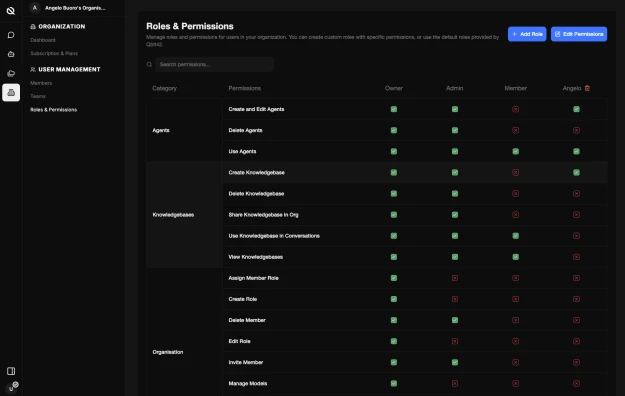
QBIT42 therefore implements a multi-layered role and permission system. The platform can initially be deployed without external internet connections and without broadly assigned access rights. Permissions are then granted selectively – based on users, organizations, agents, skills, tools and knowledge bases.
The knowledge layer plays a particularly important role. It is not solely the agent that determines which information it can use. The permissions assigned to the respective knowledge base and its underlying documents are also taken into account.
This ensures that agents can only work with information for which they have the appropriate access permissions.
External connections are not enabled by default either. Whether an agent is allowed to perform a Google search or access an external API is determined by the corresponding administrative permissions.
Organizations retain control over which data is processed, which systems are connected and which actions their AI is allowed to perform.
In addition, customer data is architecturally excluded from being used to train language models through QBIT42.
