
QBIT42 provides everything needed to turn a language model into a capable AI assistant. Organizations can define what their AI should be able to do, equip it with the tools required to perform those tasks and connect it to the systems and data they already use.
Skills – Define What Your AI Can Do
Skills give AI agents specific capabilities and instructions for performing tasks. They define how a particular process should work, which steps need to be followed and what the expected outcome should look like.
For example, a company can create a Skill that guides an AI agent through a structured job interview, analyzes employee performance reviews or generates standardized quarterly reports. Instead of relying on the language model to figure out every detail on its own, the Skill provides a reusable framework for completing the task consistently.
Skills can be created directly through the chat interface or configured in detail using the QBIT42 platform. This allows organizations to build and refine their own capabilities without having to write code.
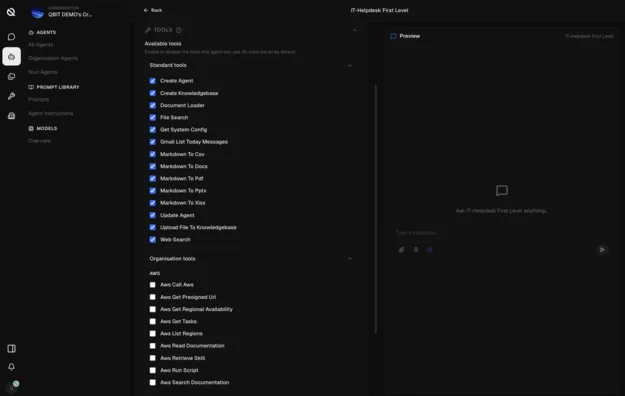
Tools – Enable Your AI to Take Action
While Skills define how a task should be performed, Tools give AI agents the ability to actually execute it.
A research Skill, for example, can define how information should be collected and evaluated. A web search Tool enables the agent to retrieve that information. Other Tools allow agents to query databases, perform calculations, create charts or import data from machines and industrial systems.
QBIT42 provides a growing collection of ready-to-use Tools. Organizations can also build and integrate their own tools to support specific business requirements.
Access is controlled at the individual Tool level. Administrators decide which users and agents are allowed to use specific capabilities. This means an agent can be equipped with exactly the tools it needs, without automatically receiving access to everything else.
Integrations – Connect AI to Your Existing Systems
AI becomes significantly more useful when it can work with the applications and information already used across an organization.
Through the Model Context Protocol (MCP), QBIT42 enables agents to connect to external applications, services and data sources. This allows agents to retrieve information and interact with connected systems, depending on the available interfaces and permissions.
QBIT42 supports integrations with commonly used services such as Microsoft, Google and Jira. Custom MCP connections can also be added to integrate proprietary ERP systems, document management platforms and other internal applications.
For enterprise environments, organizations can also operate their own MCP servers, giving them greater control over how internal systems and processes are connected to their AI environment.
One Flexible Ecosystem. Your Capabilities. Your Control.
Skills, Tools and Integrations work together to give AI agents the capabilities they need to perform real business tasks.
Organizations can build their own tools and Skills, connect existing systems and determine exactly how these capabilities can be used. Everything is managed through the QBIT42 permission system, while the underlying capabilities remain independent of the language model being used.
Skills and Tools created within QBIT42 can be exported and taken along when changing platforms or providers.
